Instructor · Practitioner
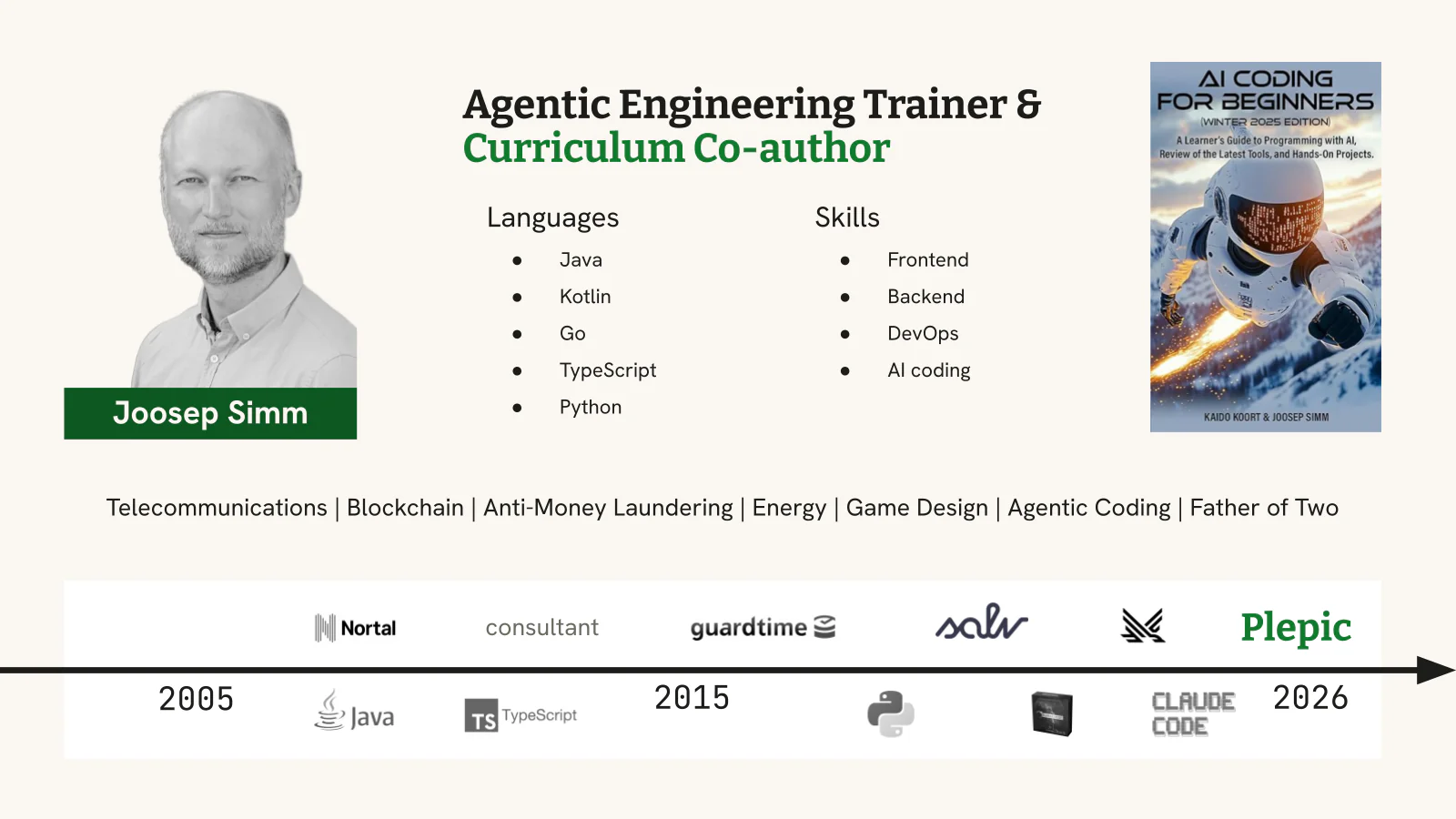
Joosep Simm

Ships code at Gridraven.
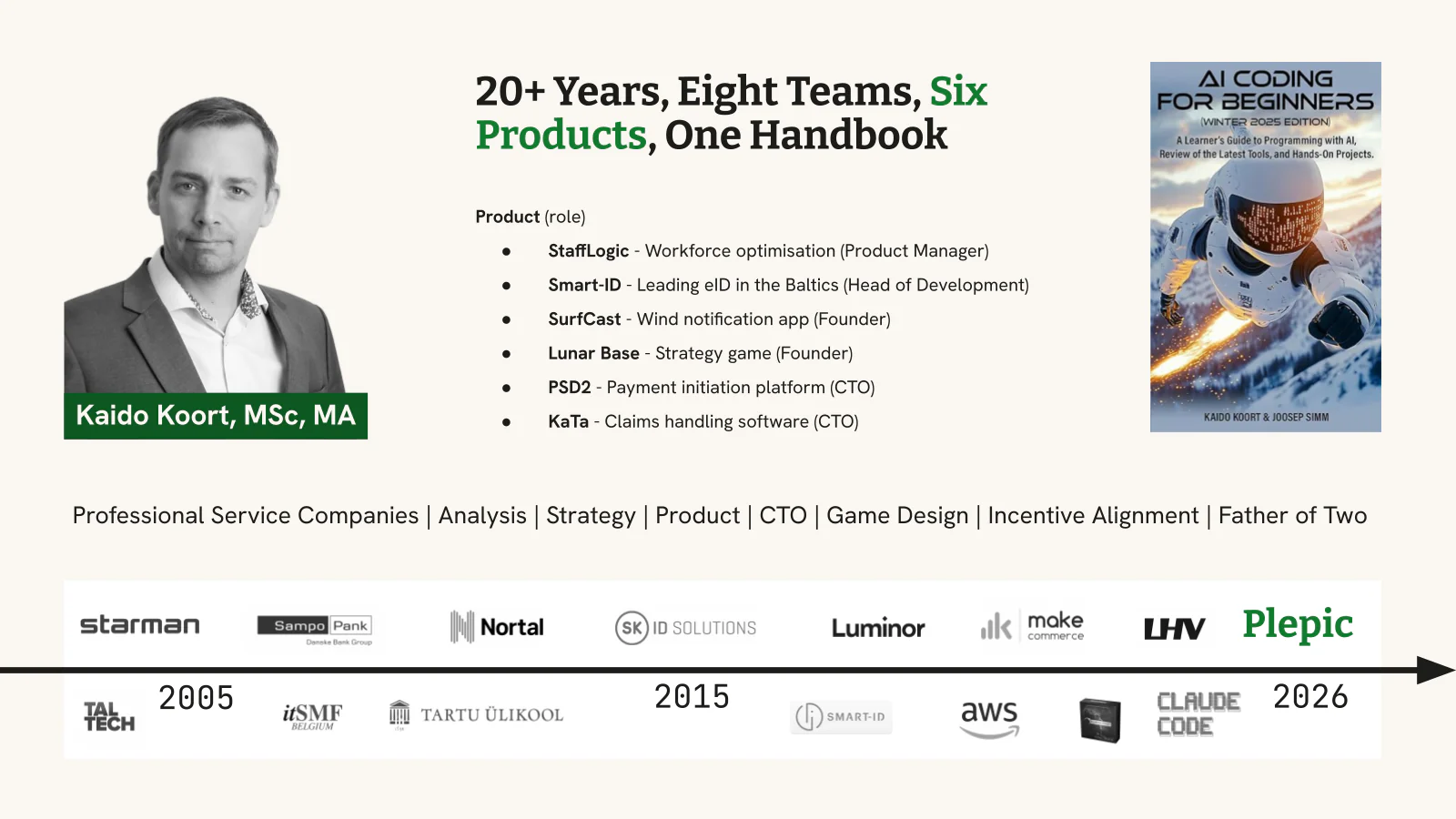
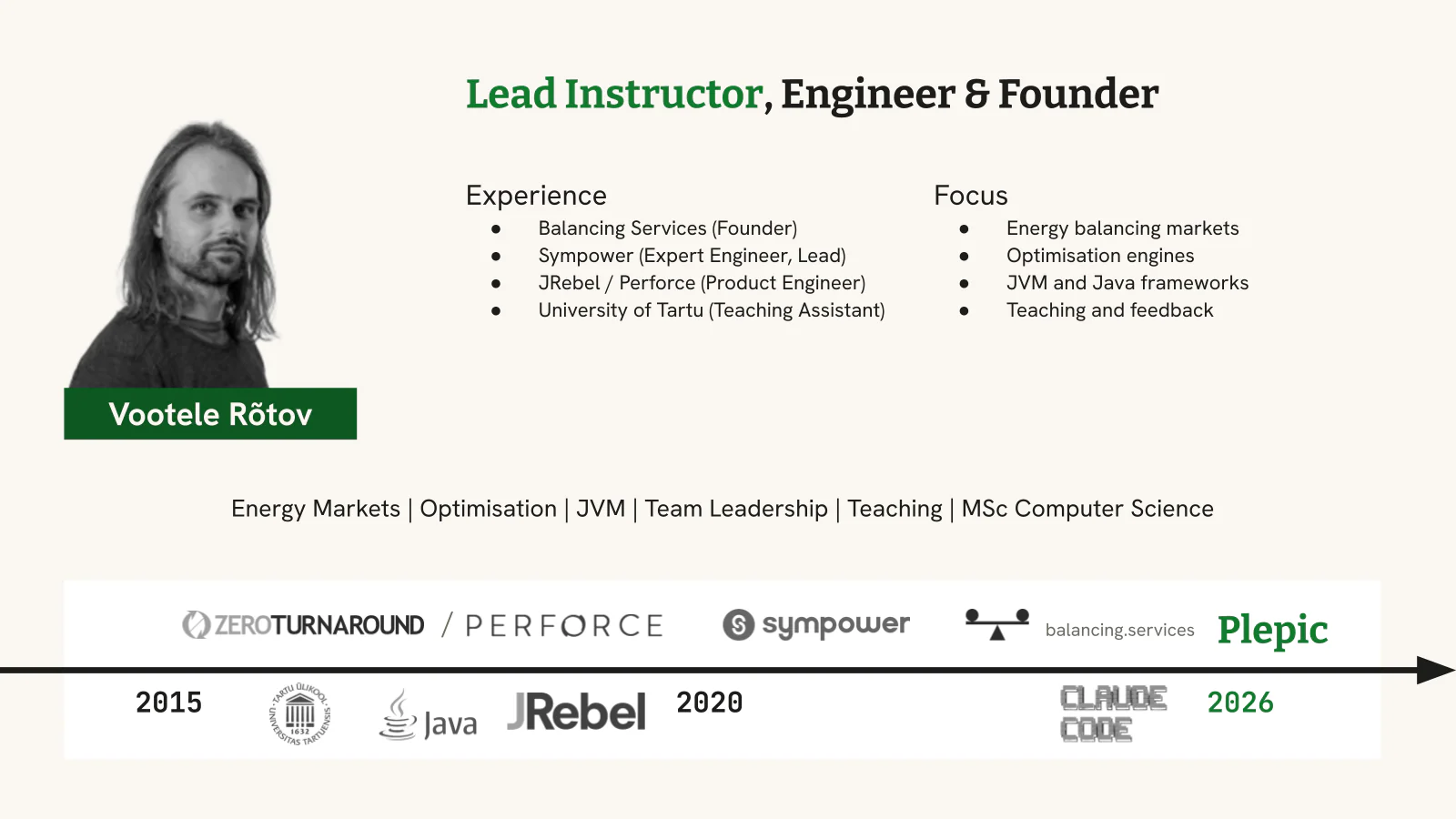
The engineers who teach our cohorts still ship production code every week. Every pattern ran on a real codebase before it reached a slide.
€2,520/dev · 🇪🇪 Töötukassa covers 80%.
For anyone with 2+ years in a software team · cohorts of ~20

Instructor · Practitioner
Ships code at Gridraven.
Instructor · Practitioner

Builds the Plepic website and product.
Instructor · Practitioner

Builds Balancing.services.
Instructor · Practitioner

Builds backthread.dev.
Instructor · Practitioner

Builds jutusta.ee.
Instructor · Practitioner

Builds Closaria AI.
The graduation project, weeks 5 and 6: built on Fridays, shipped on Monday.
Graduates self-report a median 5× speedup on their final project, estimated at course end against their previous methods. Basis: 25 answered, 20 gave measurable comparisons; cohort medians 7.5× and 4.2×.
“The biggest value was a mindset shift: not using AI as a tool, but building architecture around it. An entirely new perspective on applying AI systematically.”
Kristina Krist, Mindworks Industries
Agentic coding is a software development approach where an LLM uses tools in a loop to plan, write, test, and refine code on its own. Unlike single-prompt AI, it iterates until your checks pass.
Claude Code keeps the whole agentic setup in plain files your team can read, version and share: project instructions, subagents, hooks, skills and MCP tools. We teach the CLI because the terminal is where an agent does real work. It runs your tests, builds and git directly, sits next to any editor, and the same setup runs headless in scripts and CI. The method itself (context, planning, verification) carries over to Cursor, Copilot or Codex.
Anyone with 2+ years in a software team, in any role: developers, testers, analysts and product managers. No programming needed: the agent writes the code, you direct it and check its work. The work agencies, product companies, and AI labs are now hiring for: walking into unfamiliar code, directing AI agents, shipping outcomes. Not for learning to code.
The training runs over six Fridays, each a full day (9:00–15:30) via Google Meet. The program covers 37.5 hours; participants apply what they learn in their own codebases between sessions.
Yes. Participants who complete the program receive a Plepic Certificate of Completion in Agentic Engineering & Claude Code. It covers Claude Code, context management, and the full agentic loop.
No. We teach the method, not the tool. Later sessions cover specs an agent can verify, verification gates, parallel agents in git worktrees, observability and agent-native architecture. Prior Claude experience helps, but it is not required. The entry bar is 2+ years of software development and access to a real codebase.
€2,520 +VAT per developer. For Estonian employers, Töötukassa reimburses 80% of the training invoice including VAT, capped at €2,500 per employee over three years; the employer applies in e-töötukassa before training starts and we prepare the application with them. Plepic koolitus (Plepic OÜ, reg 11275881) is the registered training provider, EHIS majandustegevusteade nr 260952, and the program meets Töötukassa’s minimum of 50 academic hours (37.5 clock hours).
Yes. The training runs online via Google Meet, in English, open to European teams at the standard price of €2,520 per developer. The Estonian state subsidy applies only to Estonian-registered employers.
A 20-minute call with Kaido. No prep, no slides, no obligation: bring one real task from your backlog and we'll sketch what an agent would do with it.
Bringing the whole team? On the same call, Kaido shows how Estonian state aid funds the training, then shapes a cohort around your team and your codebase.
Book a 20-minute callOpens Google Calendar to pick a time